
DeLaval Flow-Adjusted Stimulation
In most of the monovac systems the vacuum and pulsation levels are set to be effective during the high milk flow. To avoid teat-damages before oxytocin release and the introduced milk let-down a delay after cleaning and before attachment is needed. This waiting period is not longer required as the system is managing the stimulation process after immediate attach of cluster.
- During the Stimu-Phase the applied vacuum is just 34 kPa, pulse 30/70 with 50 bpm.
- The main-phase is at 42-44 kPa, pulse 65/35 and 60 bpm.
- Take-off level is between 300-1000 g/min, depending on breed and milking-interval.
Key benefits
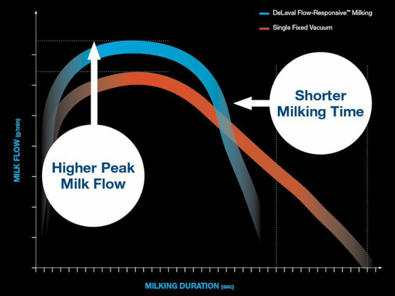
Improved milk-letdown
- Stimulation adapted to udder-filling
- Reduction of bimodalities

Assisting udder health
- Reduction of bimodalities
- Reduction of cups-on time

Improved working-conditions
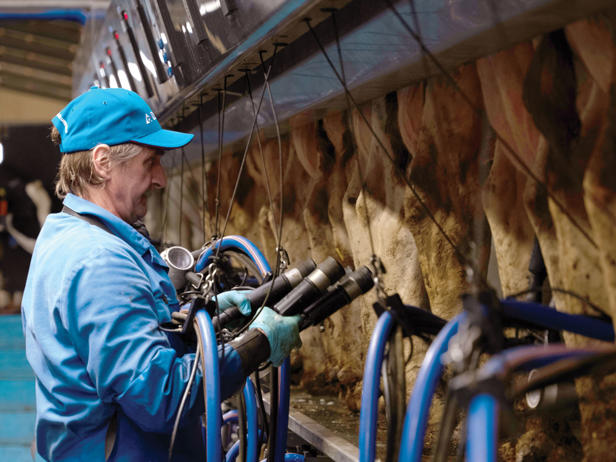
- Improved processes for milkers as they are spending less time to provide manual stimulation
- Fewer steps for milkers in parlours
- In rotaries a one-person-operation is achievable („Go Solo“)
See how it works


Why is it better?
The Balance between Push and Pull
- 66% less walking distance[1,2]
- 24% less preparation time[1,2]
- 15 seconds less cups-on time[1]
- 40% reduction in bimodalities[1]
- >10% faster / -50 seconds last cow ready with flow-adjusted stimulation[1]
[1] These are results producers were able to achieve on test farms. Results may vary and are not guaranteed. Difference can be seen related to numbers of milkings per day. [2] Data recorded in static parlour.